This week in EDCI 336 we learned about several models outlining how to integrate EdTech in the best way for student learning. Specifically, we focused on the Community of Inquiry (CoI), SAMR, TPACK, and Technology Integration Matrix (TIM) Models. Today, I will be providing a brief overview of CoI and SAMR, and a slightly deeper dive into TPACK.
Community of Inquiry (CoI)
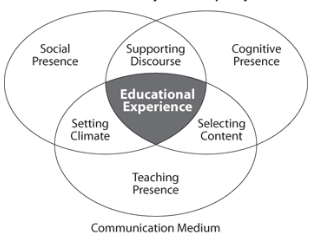
Current experts describe CoI as a theoretical framework that represents how deep and meaningful learning experiences are created via development of three interdependent elements:
Social presence is “the ability of participants to identify with the community, communicate purposefully in a trusting environment, and develop inter-personal relationships by way of projecting their individual personalities.” It establishes a feeling of trust, a sense of belonging, a sense of control, a sense of accomplishment, a willingness to engage, a conversational tone, and a questioning attitude
Teaching presence is the design, facilitation, and direction of cognitive and social processes for the purpose of realizing personally meaningful and educationally worthwhile learning outcomes. It involves instructional management facilitating discourse, direct instruction, and includes instructional design
Cognitive presence is the extent to which learners are able to construct and confirm meaning through sustained reflection, discourse, and use of metacognitive processes.
SAMR
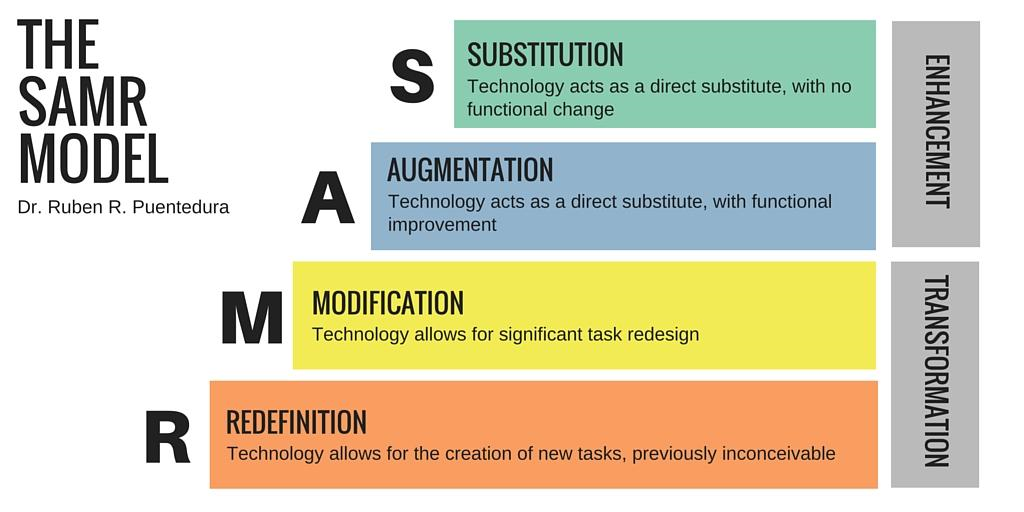
The SAMR Model is a four-level taxonomy that describes how technology impacts teaching and learning. I found Bates (2019) to have provided the most useful overview of the four levels of SAMR:
Substitution: In this level one form of technology is substituted for another. For example, a video recording of a classroom lecture on water equality is made available for downloading by students. Students are assessed on the content of the lecture by written exams at the end of the course
Augmentation: In this level, the technology substitution changes the function of the task. For example, a video lecture is embedded in a Learning Management System (LMS), and edited into four sections, with online multiple-choice questions at the end of each section for students to answer
Modification: In this level, technology integration results in a significant redesign of the task. For example, an instructor provides video recordings of water being tested. The instructor asks students to analyze each of the recordings in terms of the principles taught in the course, in the form of essay-type questions that are assessed
Redefinition: In this level, technology is used to create a new task that would not be possible without the technology. For example, an instructor provides readings and online guidance through the LMS. Students are asked to use their phones to record how they selected samples of water for testing quality and integrate their findings and analysis in the form of an e-portfolio of work.
Technology, Pedagogy, and Content Knowledge (TPACK) Model
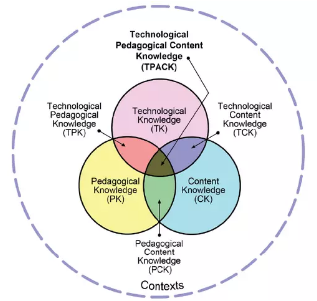
TPACK (Mishra & Koehler, 2006) is a model that frames thinking about teaching knowledge, and how content knowledge, pedagogical knowledge, technological knowledge, and their overlapping areas interact and effect the ways teachers teach, the tools they use, and the content they teach. Personally, I found it to be the most helpful model as it helped me make concrete abstract ideas I had about interactions between pedagogy, technology, and learning content. Here are the seven types of knowledge TPACK defines:
Content Knowledge (CK): Describes the knowledge about the topic being taught and associated knowledge.
Pedagogical Knowledge (PK): Describes the knowledge about teaching and techniques to help students learn.
Technological Knowledge (TK): Describes the knowledge about technology being used to teach.
Pedagogical Content Knowledge (PCK): Describes the knowledge about teaching techniques specific to the content. Example: For a lesson about complementary colours, this might include illustrations to include in a mini-lecture to overcome students’ misconceptions or things to include in the sketching practice to help students understand different aspects of putting colours together.
Technological Pedagogical Knowledge (TPK): Describes the knowledge about how to teach with the necessary tools. Example: For a lesson about complementary colours, this might include the best way to use the media to see the complementary effect and the best way to organize the sketch practice, so that it is simple for students to share their work in the gallery walk.
Technological Content Knowledge (TCK): Describes the knowledge about how the tools work with the content. Example: For a lesson about complementary colours, this might include how different media shows complementary colours differently and how different tools you could use for the gallery walk will display art differently.
Technological Pedagogical and Content Knowledge (TPACK): Describes the knowledge about the tools and techniques you use to teach the content. Example: For a lesson about complementary colours, this includes the practical detials of how you share the mini-lecture and examples, how students work on the sketching practice, how the material is gathered for the gallery walk, how the walk is done and how students reflect on what they learned afterwards.
This is a useful resource that simplifies TPACK in 2 minutes, and below are my notes I took while watching the video:
- Framework that combines 3 knowledges areas
- Technological knowledge
- The partner – the appropriate technology
- What tool will we select to make the content more accessible to the students while supporting the pedagogical strategy which we’ve identified will help to deliver this information to students
- The partner – the appropriate technology
- Pedagogical knowledge
- The “how”
- Every teacher has tools
- Ex. Direct instruction, group discussion, modeling, graphic organizer, debate, inquiry, think-pair-share
- Every teacher has tools
- The “how”
- Content knowledge
- The “what”
- The subject matter we’re teaching
- Ex. Ecology, music, algebra, health, geometry, art history, etc.
- The subject matter we’re teaching
- The “what”
- Technological knowledge
- Looks at how the 3 knowledge areas work together to increase student motivation and make the content more accessible to students
- TPK knowledge allows us to understand how we’re making the content more accessible
- TCK knowledge allows us to identify the affordances of pairing the appropriate technology to the content
- PCK knowledge allows us to identify the affordances of pairing the appropriate pedagogical strategies with the content
- TPACK is the centre spot – “where all 3 knowledge areas work together”
These are questions based on the TPACK model that helped me think richly about teaching and learning:
- How does what you know about your content affect how you choose to teach it and vice-versa (PCK)?
- How does what you know about your content affect the tools you use when teaching and vice-versa (TCK)?
- How does what you know about teaching affect the tools you use when teaching and vice-versa (TPK)?
- Finally, how do all three of these types of knowledge mesh together when you teach (TPACK)?
- If you need to change the content being taught in an activity, how would you change the pedagogy and technology to teach this?
- If you bring a favourite technology to an existing activity (or have to stop using a technology), how would it change how you teach and what content you choose to include in the activity?
- If you try a new pedagogy for an activity, how does it influence what you choose to teach and which tools you use to support it?
TPACK is extremely helpful because it puts important conceptual domains of teaching into a highly comprehensible interactive model that teachers can quickly think about every time they teach a lesson. However, the students in a teacher’s classroom have a strong impact on what content, pedagogical approaches, and technology teachers can use, and I do not see how TPACK integrates these important relationships.


Leave a Reply