This week we discussed GenAI and its role in education. Whether we like it or not, GenAI is something that our students will grow up with. There are appealing benefits of this technology but also many concerns and issues, as Randy put it the “perils and promises”. GenAI is already “baked in” to so many of our everyday applications, from Spotify to google. It offers a level of convenience that is hard to hold back from, and arguably can help reduce the mental load, freeing up a persons energy for more important tasks. That being said, GenAI is not perfect. From “hallucinations”, “AI slop” to very convincingly written but incorrect information, can we really trust AI to do what we’d like it to. In terms of education, the major discourse is how to proceed, do we ban GenAI completely to prevent cheating? Do we guide AI use for students? or do we fully embrace the benefits it has for education? The following reflection outlines my torn stance on the matter, on one-hand I’ve found GenAI to be extremely helpful in creating resources, and I foreseen it being a powerful tool as a teacher, however I have concerns in its use by students, with potential to lead to lazy students who lack creativity, resilience and critical thinking as a result of heavy AI use.
For a more in-depth and engaging summary of the content learned this week, check out this 7 min video, created by NotebookLM based off the transcript from Randy’s pre-class video.
Reflection
Utility of GenAI Tools for Creating Resources for Teachers
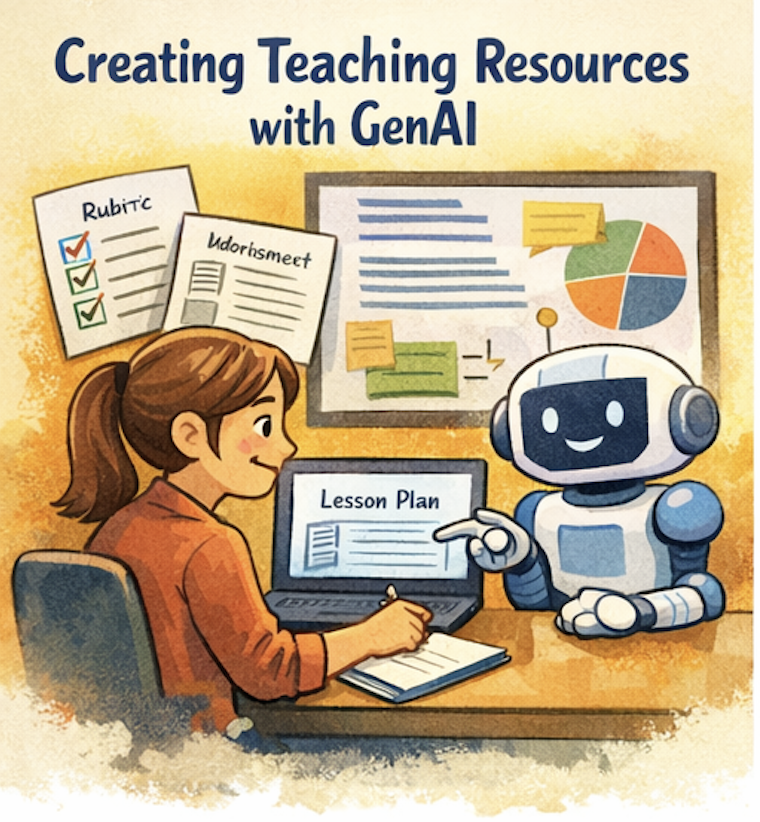
I’ve used ChatGPT to create some teaching resources for this program (referenced of course). And I’ve found it to be extremely helpful. I usually have a well thought out idea prior to bringing it to ChatGPT, however it has been helpful for improvements or filling in the gaps. For example, I’ve often used it to strengthen a lessons connection to the curricular goals. I’ve found that the more flushed out the idea is the better the outputs. In this week’s activity, I asked ChatGPT to create a lesson plan without an idea to scaffold the response (link to the chat log here). I found that the idea was good but required heavy editing to make it actually usable in a classroom setting. I think using an idea to scaffold the response helps make the resource or activity more usable – because a human with teaching experience has developed the core of it. It’s also be quite helpful for creating learning targets and points on a rubric, giving observable examples for each point and level.
Our group inquiry project for this course will explore how GenAI can be used to help teachers. I plan to look into the diversity of ways it can be useful for creating resources such as lesson plans, worksheets, posters and slide shows. From my preliminary research I’ve found many cases in which teachers use GenAI to create differentiated worksheets or readings, practice questions, discussion questions, helping with assessment and writing feedback. This website lists 66 ways GenAI can be used to help teachers with their work load. The list is lengthy, and made me think of what would be left for teachers to do? This article talks about how AI tools cannot replace teaching pedagogy. I agree with the author, that connection is a fundamental component of teaching and this cannot be replaced by AI. Even looking at the list in the first website (ironically generated using AI) I question the ethical and feasible implications of using AI tools for all of those things. At the end of the day, a teacher has to bring something to the table. I think that is why I feel so strongly about developing my own ideas prior to using AI tool to enhance them. However, as a pre-service teacher, I don’t have actual experience in all the realms of teaching so I cannot confidently comment on what is and isn’t useful or feasible just yet.
Concerns of Students Using GenAI
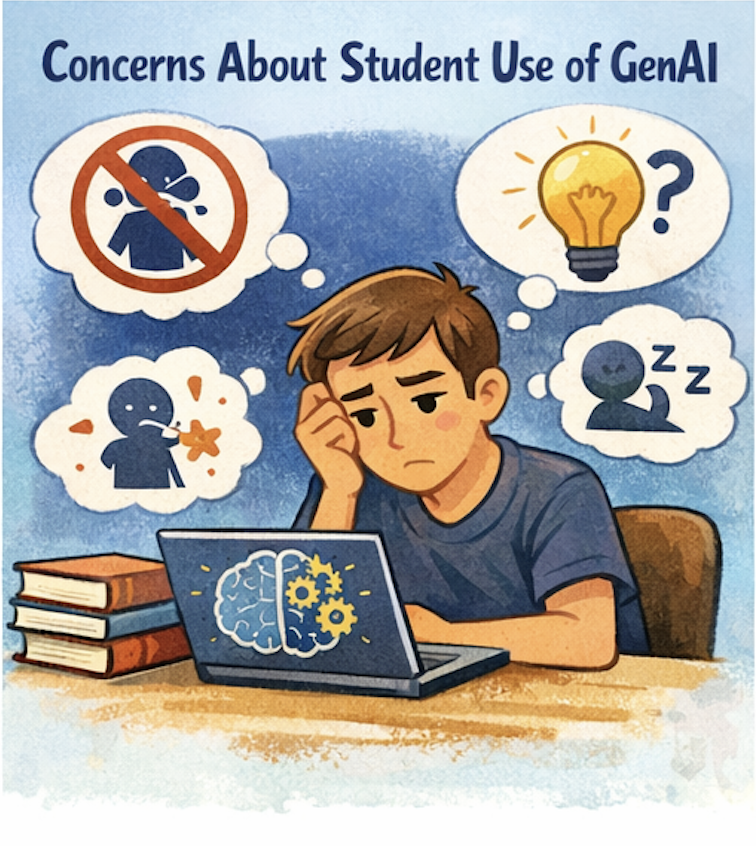
I feel a little hypocritical being open to using GenAI tools to help with my workload as a teacher but apprehensive and opposed to students using the same tools. However, I’ve done my time as a student. I have the critical thinking skills and a sense of rationality required to use these tools responsibly. I have a sense to fact check information, check over the work, and provide it with insightful prompts. I think students would struggle to use them responsibly. More importantly, I did the work in school without AI in order to develop those critical thinking skills, as well as creativity and resilience. This article found that GenAI has potential to enhance creative education in students it also can be harmful to creative confidence. Why do the work if AI can do it better? This article refers to it as “cognitive laziness” in which students are regularly offloading higher order cognitive tasks to AI. How do we ensure our students are not offloading these tasks at a time in their development where doing these tasks contributes to their cognitive development.
I wouldn’t introduce GenAI to my intermediate grade students for these reasons. I don’t think it is responsible to give students tools that can so easily replace the thinking practice they need for development. As an adult who uses it occasionally, I know how slippery the slope is. The convenience becomes addictive, and I’ve found myself offloading more than I’m proud of. I at least can recognize and understand the consequences of this, whereas children might not. Furthermore, students will find GenAI in their free time. I don’t doubt at some point my own students will surpass my GenAI skills. I don’t think it is worth spending time on something that students will explore on their own. That being said, I do think it is important to give them the knowledge and understanding of these tools and give them practice in critically thinking about the output and materials they are interacting with online. Teaching from a point of safety rather than exploration.
Discussions with my Peers
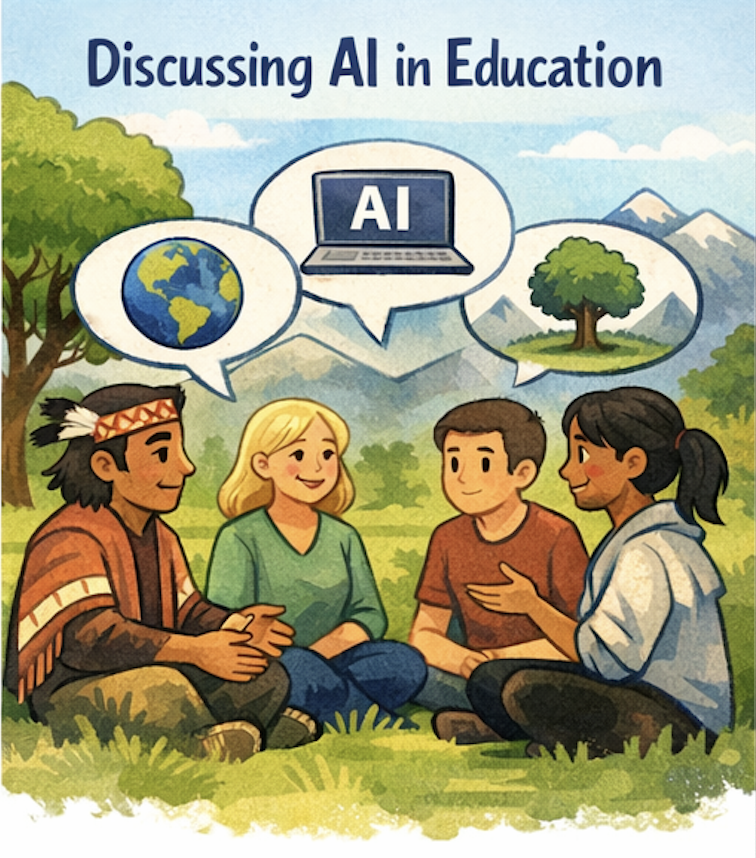
This lecture sparked significant discussion amongst my peers and myself. While it seems like a powerful tool for us as future teachers there are many ethical dilemmas that were brought up. Our Education Philosophy course is discussing the First Peoples Principles of Learning this week and it seems to be in direct opposition of using GenAI in education. The FPPL is based in connection with oneself, their community and the land. More information on the pedagogy can be found here using your UVic library account. How does GenAI fit into this praxis? Does it? Some of my peers, myself included, hope to teach from a land-based approach so are apprehensive of AI in the classroom. However, from my above reflection you can probably tell that I do find them useful, resulting in an uncomfortable feeling of imbalance in my teaching praxis.
AI Generated Images for This Post
I asked ChatGPT to make me three images to go along with the three sections of my reflection. Accurate to the content, I find them mundane and very similar to much of the graphics online already. Mind you I didn’t add much to my prompt, simply asking for graphics. I’m sure I could have been more specific and got more unique images. I also question if the third image of an Indigenous person is bordering on stereotyping? I left the image in as is to demonstrate the need to be critical about GenAI output.


Leave a Reply