In class this week, our focus was on game-based learning and gamification. The beginning of our class began with a presentation from Kara Dawson, who works for Comox Valley School District as the District Information Technology Support Teacher. She introduced us to Minecraft Education, and the ways in can be used to support learning within classrooms. Minecraft Education can promote collaboration between students, critical thinking, and problem-solving skills. As well, within Minecraft, there are lots of pre-built words and areas that are subject-specific. Kara also really emphasized having explicitly setting expectations for students when using Minecraft Education to ensure the game is used properly. Overall, I found Minecraft Education to be really interesting and engaging and I hope to be able to make use of it in a classroom one day.
Gamification and Game-based learning
Our class then had our usual lesson where we learned about the differences between gamification and game-based learning. Gamification involves enhancing learning by adding digital elements into lessons. Examples of this can include using Kahoot to engage a class to study for a quiz. This reminded me of the Augmentation phase of the SAMR Model I learned about last week. Game-based learning occurs when learning takes place within a game. For example, Minecraft Education can be used to allow students to learn about camas in social studies by interacting with Indigenous Elders in the game. This part reminded by of Redefinition phase of the SAMR model, where learning is entirely changed and allows for activities that would not normally be able to occur.
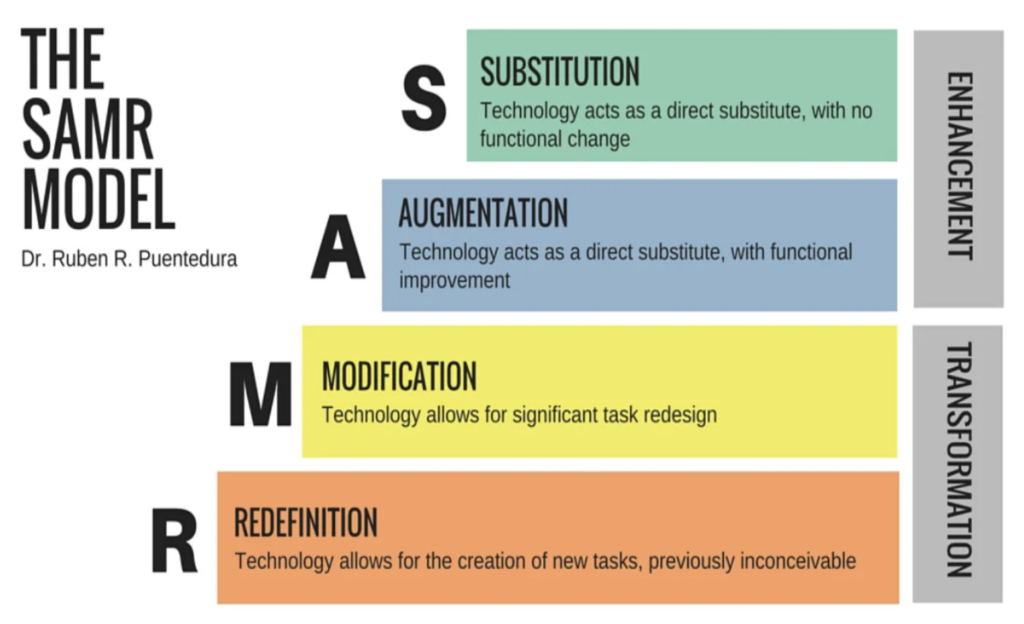
Image of the SAMR Model.
Following our lesson, we had the opportunity to test out some games. One of the games I tried out was GetBadNews. In this game, players are to spread fake news using different approaches such as spreading conspiracy theories, trolling others, smear campaigns, and pushes extreme political ideologies. Players are encouraged to build a platform using fake news, trying to accumulate a mass following, and keeping a relatively intact credibility with followers. This game focuses on digital literacy and being able to identify misinformation, disinformation, bias, and credible sources. While I understand that the purpose of this game was to likely try to get students to think about how fake news spreads and harms it can cause, and the credibility of where information is sourced from, I did not particularly enjoy how the game would encourage and prompt players to continue to choose prompts that the game wants you to choose. I worry that this could be taken the wrong way by users who are young and impressionable, and are not able to recognize the harms that occur in real-life from these actions.


Leave a Reply