Over the past week, we explored gamification and game-based learning. To begin the last class, we got a presentation on Minecraft. Specifically using Minecraft in an educational setting, which can, in turn, hit curriculum goals, enhancing student learning. Minecraft education can be so engaging for students and could very possibly increase their learning of the material and encourage them to explore their own creativity. I am looking forward to seeing whether the district I end up working in offers computers as an option and, therefore, has access to Minecraft Education. This would be super cool to see how the students (with scaffolded tasks and expectations) flourish on this type of platform.
Gamification, in simple terms, is the integration of game elements into usual learning activities to increase motivation (EDCI 336 Brightspace). Game-based learning has learning activities embedded into the game and can also increase student engagement. Of these two, neither is necessarily better than the other; they serve different purposes. Sometimes it will be easier to gamify a lesson or a usual classroom routine, but sometimes it can be designed with the content to create a game-based lesson.
During class time, we dove into some games that students could use. I chose to explore the game “Harmony Square“. Harmony Square is an online game that simulates an online presence, specifically as a Chief Disinformation Officer. This game runs the user through a dialogue with the program and the user. The user has only 2 choices to respond. This game is about democracy in a made-up town where the news always has something exciting in the headlines, and the character being played by the user is trolling people online (feeding them fake information to get more comments and reposts, whether pro or against the post). The term they use in the program is “rage bait,” which means making people angry because the statement is not true, and people want to correct it, which frustrates them. This program is designed to help students gain awareness of their online presence and of others’ online presence as well. I had no idea what to expect when interacting with this program, and at first, I just taught students to troll other people online, but I can see that it has a deeper meaning to teach students for the better. A downside to this game is that it is very text-heavy and therefore relies on reading. If students were not proficient readers (depending on age), the program may be challenging.
Overall, I believe that both gamification and game-based learning are essential in the classroom and can help students engage more with the material, thereby increasing academic outcomes. Some students might even learn better through a game rather than traditional classroom instruction.
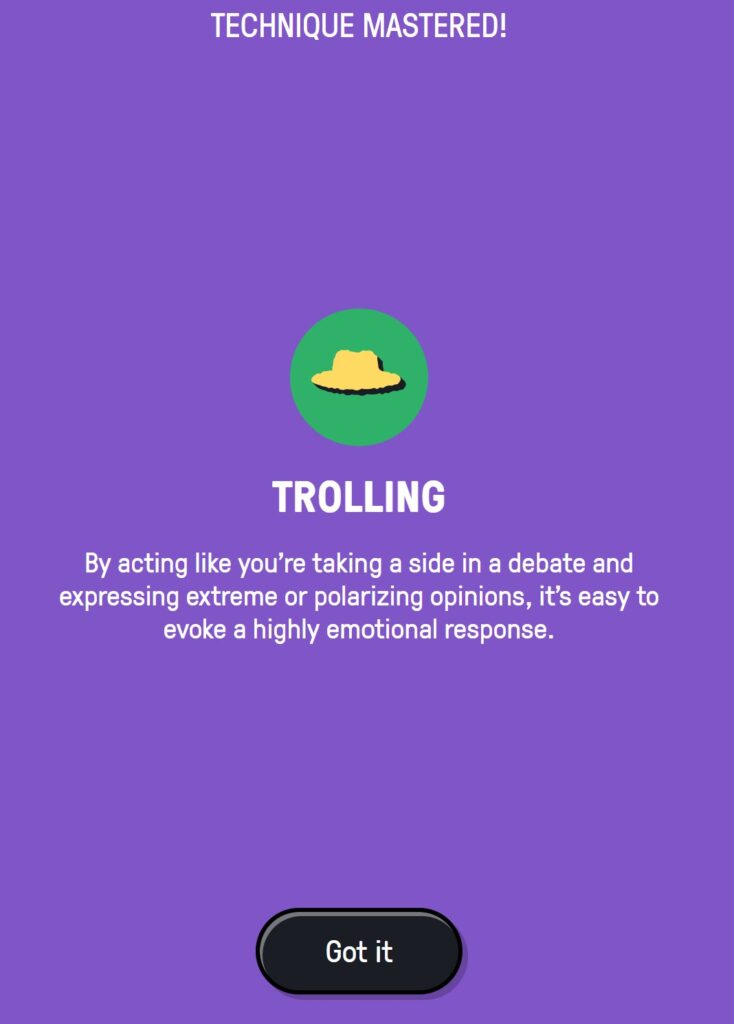

Images from the Harmony Square online game (linked above).


Leave a Reply