For my Inquiry project, I have decided to explore “How to succeed as an early-career teacher during the transition from teacher-education”. As our first practicum gets closer and closer, I (and I’m sure many others) am feeling an increasing level of stress about my preparedness. While teacher-education at UVic has certainly given me lots of strong information to build my career from, I have repeatedly heard from current experienced teachers that actually working as a teacher can be a different reality; and thus, I wanted to conduct a deeper investigation of how to succeed once we’re in the “real world” of teaching.
A Lay of the Land
To understand how to succeed as early-career teachers, I figured it is important to first understand the broader context and systems we are becoming a part of – and so I set out to gather information about the structure of the BC Education System.
The initial roadblock
Very quickly into my search for information, I realized that I had a resource problem. While there are many resources about various systems and roles in the BC Education System, most of them are pdf files over 100 pages long that weren’t particularly useful for generating a broader understanding of the entire structure. The same issue applied to documents for new teachers and TTOCs.
With these issues in mind, I determined the best way for me to get a broad view of the education system would be to ask ChatGPT 5.2 to give me a relatively basic rundown, while at the same time not prompting it to give me specific or in-depth details that it may not respond to accurately. I then fact-checked and sourced the information it provided me to the best of my ability.
Here is what I found:
Alongside professional organizations such as the BCTF, there are three different hierarchical “levels” of BC’s Education System that all influence each other bidirectionally, either directly or indirectly: the provincial level, district level, and school level.
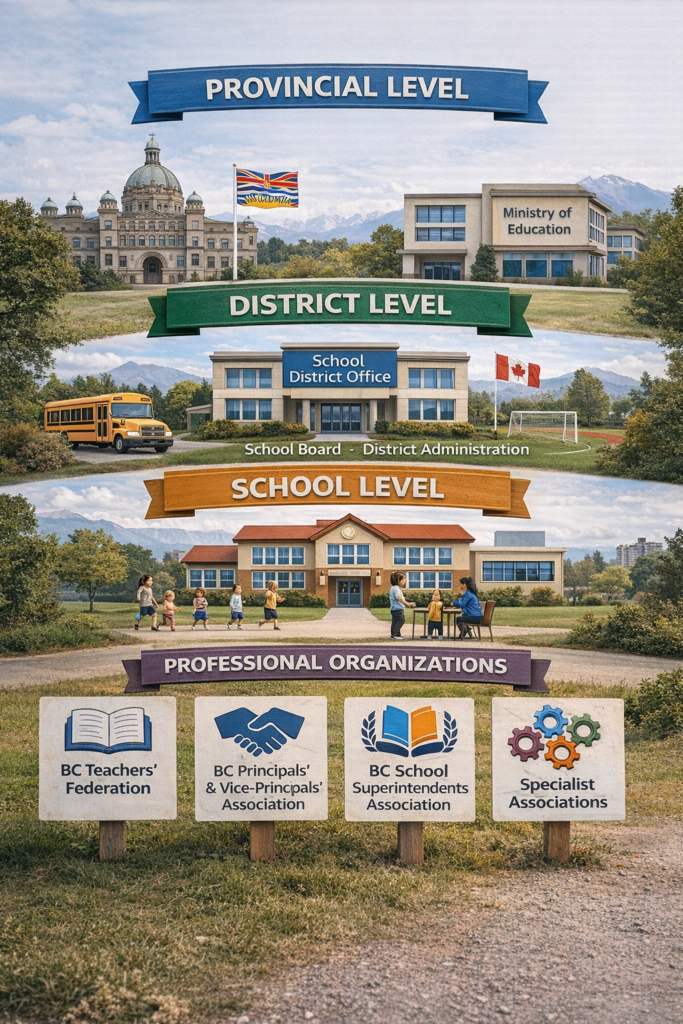
Image created by ChatGPT 5.2
The Provincial Level – Policy, Law, and Direction
- The first key body at the provincial level is the BC Ministry of Education and Child Care. It’s core function is to set the framework for education in BC, and it is responsible for creating the curriculum, setting legislation, funding districts, setting systemic priorities, and conducting workforce planning.
- The second key body at the provincial level is the BC Teacher Regulation Branch (TRB), which is technically part of the BC Ministry of Education and Child Care. It’s core function is to protect the public by regulating the profession of teaching. It is responsible for teacher certification, the professional standards, assessing fitness to teach, and conducting discipline and conduct reviews.
- The third key body at the provincial level is the BC Teachers’ Council. It governs ethical and professional conduct; it is responsible for overseeing professional discipline, maintaining public trust, and setting ethical expectations
The District Level – Local Implementation
The central role of the district, as I understand it, is to turn provincial policy into local practice, acting as the bridge between the province and schools.
- The first key body at the district level is the Board of Education, composed of democratically elected officials whose job it is to represent the public by setting district priorities and policies, such as budgets, and the hiring and supervision of a superintendent.
- The second key body at the district level is the Superintendent – the chief educational leader of the district. Their responsibilities are to implement the ministry and board directions, provide instructional leadership, oversee principals and district staff, and to determine and strategize district-wide learning priorities. Most (if not all) district boards seem to provide a document describing the role of the superintendent.
- The last key bodies at the district level are the district departments, such as HR or Indigenous Education, who serve various functions as related to their domain of expertise.
The School Level – Daily Practice
- The principal is a key individual at the school level whose role is to be the instructional leader and manager of the school. Responsibilities for principals include teacher supervision and evaluation, guiding school culture, providing instructional leadership, safety and discipline, parent communication, and staffing.
- Another key individual at the school level is the vice principal. Alongside operational responsibilities, they are responsible for behaviour, student support, timetabling, and crisis response.
- Teachers are of course key individuals at the school level. A shortlist of their responsibilities includes planning instruction, giving instruction, assessing learning, building relationships, implementing curriculum, collaborating with staff, and providing a safe and inclusive learning environment for students.
- Various support staff can be conceptually integrated into the school level. Counsellors, EAs, librarians, and SLPs all serve unique and important roles inside schools.
- Parents and guardians are partners in learning who frequently advocate to those in other parts of the system. Their life experiences and backgrounds influence the school community.
Professional Organizations – Advocacy and Development
- The BC Teachers’ Federation is the teachers’ union in BC. It advocates on behalf of teachers to maintain and improve working conditions and ensure professional rights. It deals with such topics as: salary and contracts, workload, grievances, and advocacy.
- Local teachers’ unions provide immediate support, workplace representation, and deal with school-level issues.
- The Teacher Qualification Service (TQS) primarily functions to determine your pay category
- There are also various professional development networks which can shape your professional identity and growth, including: Professional Specialist Associations, Mentorship Programs, and learning networks.
What’s Next?
In my next blog, I will ask and explore questions that this broad, relatively simplistic review of the entire BC Education System resulted in. I also intend to identify where and how new teachers fit in. After this part of my inquiry, I intend to define what it means to be “successful” as an early career educator.


Leave a Reply