Designing for learning is an important part of teachers’ lesson planning and execution. Today, we will exploring Understanding by design, ADDIE, and CAST’s Universal Design for Learning – key resources made to help teachers design rich, accessible, and adaptable learning experiences for their students.
The central purpose of UDL is to help educators proactively develop learning experiences that are accessible to all students, regardless of their needs, from the very beginning. Ensuring this means ensuring learning activities have multiple means of representation, multiple means of action & expression, and multiple means of engagement. UDL guidelines differ from typical differentiation in that they are proactive, as opposed to reactive; support all learners, rather than differentiating for specific students; and remove barriers entirely, rather than simply adjusting the difficulty of activities or support provided to specific students.
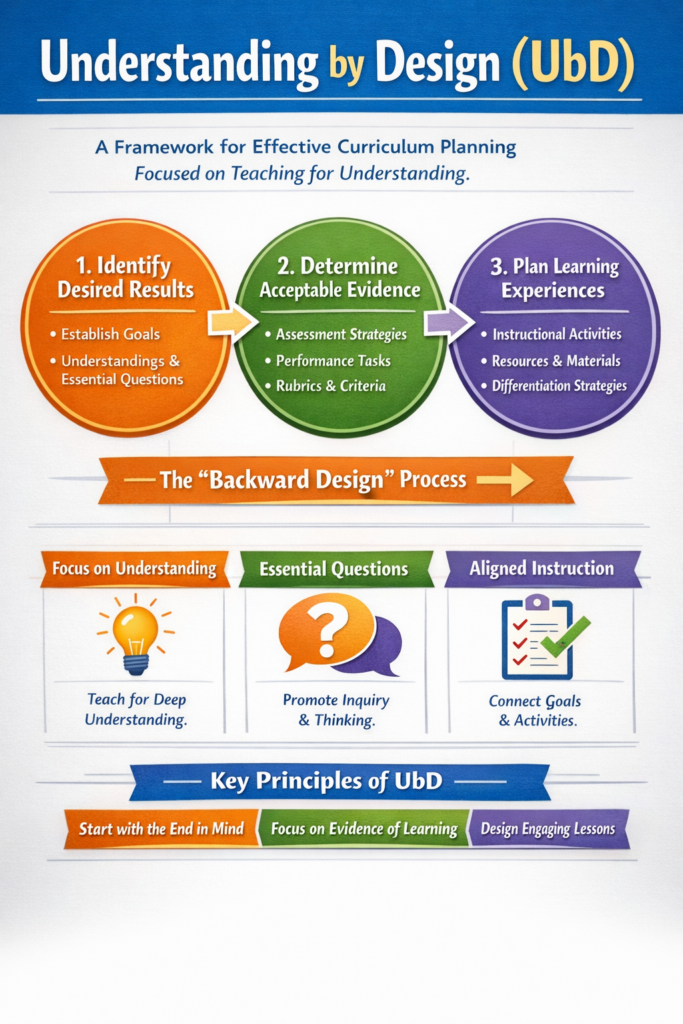
Understanding by Design is a backwards design framework created by Grant Wiggins and Jay McTighe. Backwards design is an exceptional tool for effective planning of learning experiences and outcomes, and operates according to a 3-step process. First, identify the desired results in terms of curricular goals and learner outcomes; second, develop assessment strategies that accurately and precisely determine acceptable evidence; and third, plan the learning experiences that students will be engaging in.
Fig . 1. “Create a resource image that explains Understanding by Design (UbD)” prompt, ChatGPT, 5.2, OpenAI, 7 Feb. 2026, https://chatgpt.com/c/69794739-3eb8-8330-babe-470e3e10e932.
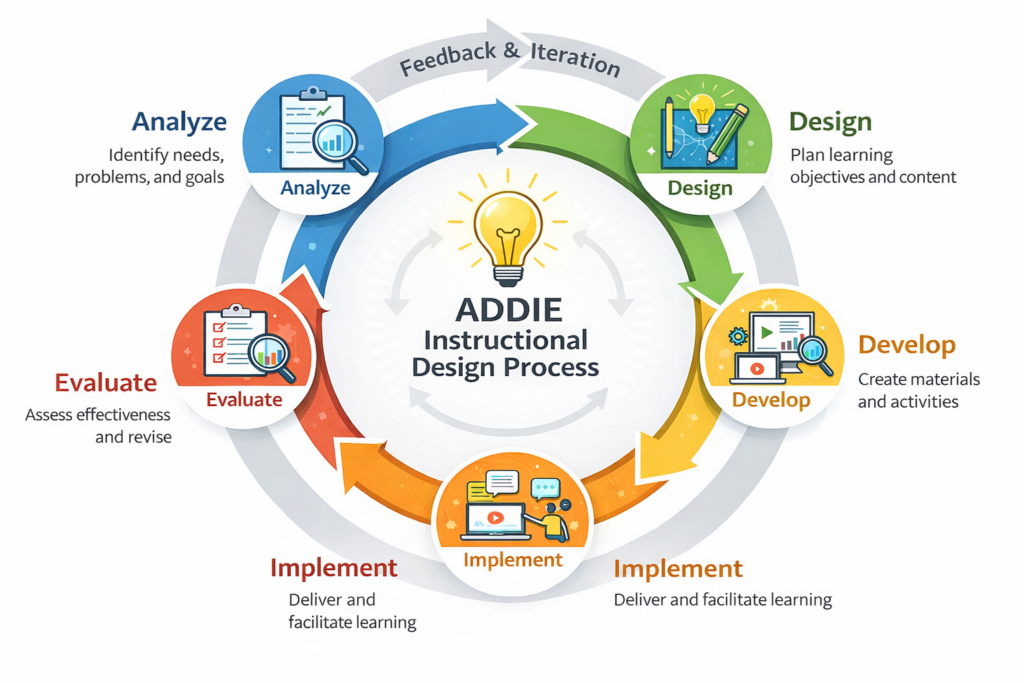
ADDIE – an acronym for analyze, design, develop, implement, and evaluate – is a 5-step instructional design process. While I use the term “step,” the linearity of the acronym’s application frequently depends on the task at hand. For example, evaluation of a pilot test may determine that reevaluation of course activities is needed (develop), or perhaps the course content(s) selected were not effective at preparing learners for the course activities (design).
Fig . 2. “Create an image of the ADDIE instructional design process as a continual cycle” prompt, ChatGPT, 5.2, OpenAI, 7 Feb. 2026, https://chatgpt.com/c/69794739-3eb8-8330-babe-470e3e10e932.


Leave a Reply