After lots of reflection and experimentation this week, I still have mixed feelings about generative artificial intelligence and its role in education.
It’s that easy! GenAI applications for teacher productivity
I think that a huge piece of GenAI’s allure for teachers is its convenience. In our AI workbook activity, I used MagicSchool to create a pretty thorough inquiry-based science unit in minutes. MINUTES! Burnout is a major issue, especially for early-career educators. GenAI could ease the burden on teachers by automating time-consuming tasks. This kind of support could free us up to spend more time and energy supporting students socially and emotionally – something that AI can’t do!
UDL and personalized learning
I’m also excited about GenAI’s potential to assist with Universal Design for Learning (UDL) and personalized learning. I love the idea of using AI to tailor lessons to students of different abilities, learning styles, and interests. One of the greatest challenges of teaching is meeting all students where they are and providing the right level of challenge for each learner. In that sense, AI feels aligned with concepts like Vygotsky’s Zone of Proximal Development. GenAI could help teachers scaffold. I tried this out with Magic School by getting it to simplify a text about biomes to a lower reading level. I think this is a great application of GenAI – using it to simplify text helps to remove an unnecessary barrier for students who have trouble reading.
Critical thinking?
One of my biggest worries is the potential decline in critical thinking and creativity. I often catch myself leaning on AI to complete tasks that I am fully capable of doing on my own. If I, as an adult, am susceptible to this habit, I worry even more about how it might affect students. Since GenAI is so convenient and pervasive, both students and educators could become dependent on it… what might that dependency mean for the development of writing skills, creativity, and critical thinking?
A study out of MIT suggests that using ChatGPT for writing tasks may reduce brain activity, mental engagement, and critical thinking! Paritcipants who relied on ChatGPT also produced less original work compared to those who used a search engine or wrote without assistance. And it appears that these results were not very reversible – people who’d relied on Chat in the past but were no longer using it STILL showed poorer critical thinking skills. There is still ongoing research into this, but it raises concerns about overreliance on AI, especially for students who are still developing as thinkers and readers.
FAKE NEWS?!
I’m also concerned about misinformation. AI has become alarmingly good at generating text, images, and even videos that look just like the real thing (see: creepy Sora videos like the one below). Without strong media literacy skills, students may be particularly vulnerable to believing or spreading false information. This makes explicit instruction around misinformation and AI literacy absolutely essential.
Fake video of a dog spewing water at a nice older gentleman created using Sora (it wasn’t me – I promise!)
What about the environment?
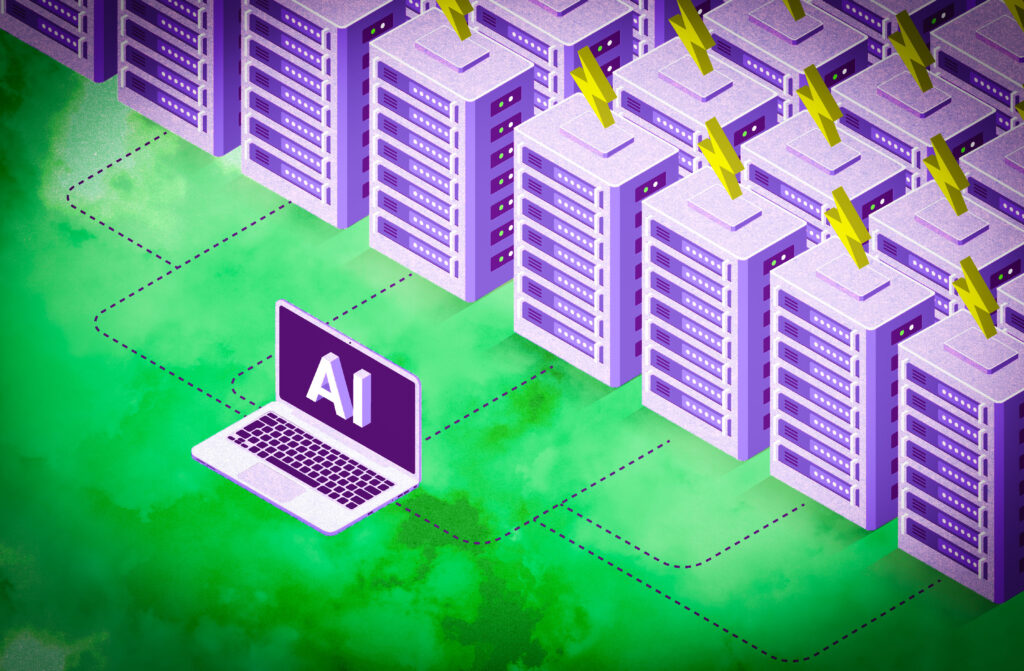
I’m also conflicted about the environmental impact of AI. Large-scale AI systems require a lot of resources (water and energy). I said this already in my AI Workbook assignment, but at times, using AI to create teaching materials feels hypocritical to me. I want to teach my students about the climate crisis and help them build a sense of connection to the land, so I feel uncomfortable knowing that my use of AI is contributing to the problem. This tension is something I haven’t fully reconciled – and I honestly don’t know if I can! For example, I’m feeling guilty about how much water I probably wasted creating a cutesy AI-generated photo of me in Sweden for my Inquiry blog 
Back to pencil and paper?
I work as an EA on call, so I’ve gotten to see a wide range of approaches to AI use in classrooms. Some teachers have responded by going fully analog for certain subjects. For example, an English 8 teacher I worked with restructured her course so that the summative assessment, an essay on The Outsiders, is now handwritten in class rather than taken home. I understand the intention behind this shift – it’s getting hard for teachers to see if students are cheating/plagiarizing with AI. However, I’m not convinced that outright banning GenAI (or designing assignments to make AI use impossible) is the best solution.
AI Literacy
AI is obviously not going away. I want students to learn how to use GenAI properly, safely, and ethically so that they are prepared for the world they are entering. This means teaching responsible use rather than avoidance. Students need to understand what AI is and how it works. We need to be clear that even though interacting with AI may feel like talking to another person, it is not a substitute for human connection. Students should be encouraged to reach out to real people when they need help or support.
My mum is a teacher at Ridgeview Elementary School in West Vancouver and a former colleague of Cari Wilson, who has created excellent AI literacy resources for K–12 students. My mum recently shared one of Cari’s AI lessons with her Grade 4 class, and I’m hoping to get a copy of it from her. I’m also excited to attend Cari Wilson’s professional development session, Student AI Literacy Lessons, through Focused Education Resources in February.
Overall, I’d say that I’m both excited and terrified of the applications of generative AI, in the classroom and beyond.


Leave a Reply