
Welcome to week 7! This week we will talk about two useful theoretical frameworks that can assist us in evaluating educational technologies now and into the future. For our hands-on lab time, we will learn to use a low-tech and then a high-tech tool to perform a similar educational task and then reflect on their relative appropriateness using the two evaluation frameworks we discussed.
Topic 7 Learning Objectives
- Describe the SAMR theory of technology adoption, and evaluate the technologies we are using in EDCI 336 using this framework
- Explain how the Triple E Framework can help us evaluate the usefulness (or not) of Educational Technology in any particular situation.
- Understand the benefits sketchnoting can provide learners when used for readings or classroom instruction
- Create a sketchnote based on a reading of an article
- Use Canva to create an effective infographic by summarizing information into graphical representations in a narrative that is aesthetically pleasing and compelling
Pre-Class Activities
Evaluating Educational Technology Tools: SAMR
The SAMR (Substitution, Augmentation, Modification, Redefinition) model of technology adoption gives us a useful framework to evaluate the potential benefits of new educational technologies:
What is the SAMR Model? (4 min)
When evaluating a multimedia learning tool, please ask yourself, where on the ladder of the SAMR Model of technology integration does it evaluate fall (see the infographic below)? If the new educational technology does more than “substitute” another technology, are the additional benefits the tool provides worth the investment of your time, your learners’ time, and your school budget compared to other tools already in use in your school district?
Please read this excellent but concise SAMR article to round out our formal learning on this tool: SAMR Model – A Practical Guide for EdTech Integration (~5 min).
REFLECTION – Please reflect on the H5P instructional video you created:
- Compared to a lecture format of instruction, where does the H5P video you created sit on the SAMR spectrum?
- Could you modify your video or H5P interactivity to move your H5P video higher on the SAMR spectrum?

SAMR model, illustrated by Sylvia Duckworth
Evaluating Educational Technology Tools: Triple E Framework
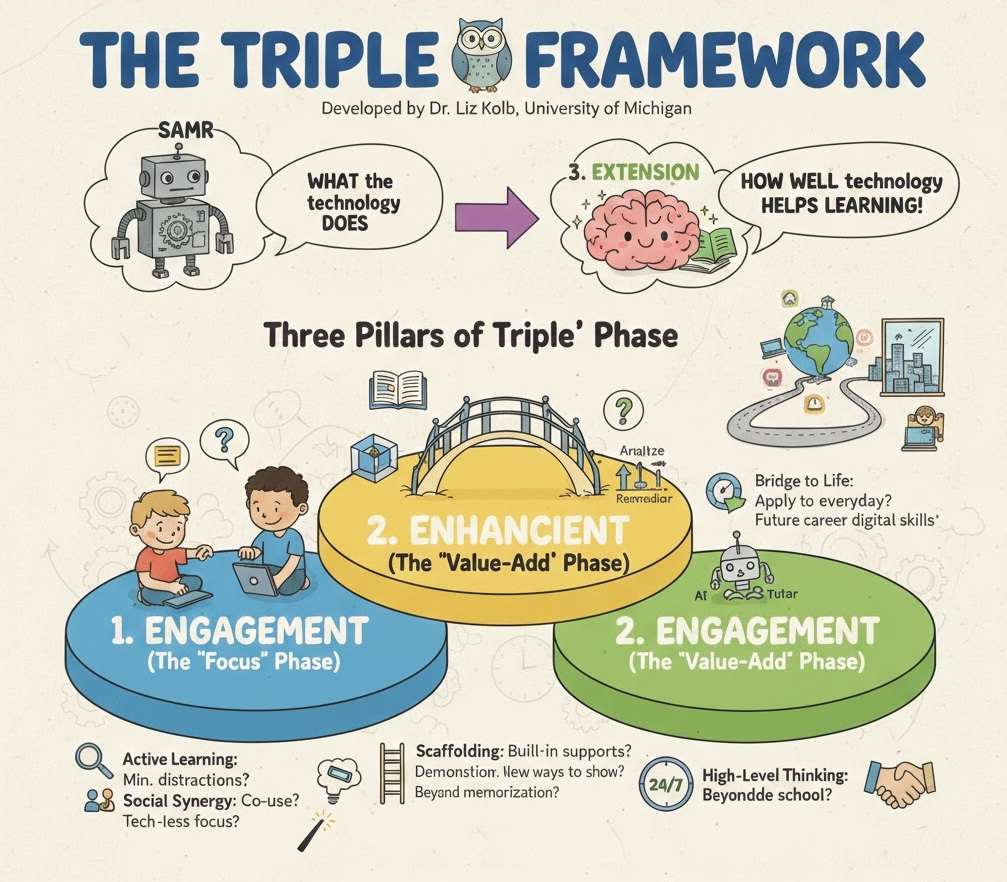
Let’s take a look at the Triple E Framework. It was developed by Dr. Liz Kolb at the University of Michigan, has become a favorite among K-12 administrators and “tech coaches” because it focuses on the learning rather than the “bells and whistles” of the software.
- Engage: Does the tool help students focus on the learning task?
- Enhance: Does it help students develop a more sophisticated understanding?
- Extend: Does it connect classroom learning to the real world?
(11 min)
Why has the Triple E Framework become a popular tool for evaluating EdTech tools? In the current era of AI, many tools “Engagement” levels are off the charts, but their “Enhancement” is often low (students just let the AI do the thinking). The Triple E Framework is being used to filter out Generative AI tools that do the work for the student, favoring tools that use AI to Enhance the student’s own cognitive process.
Gemini 3.0 (2026)
Which Model Should I Use: SAMR -or- Triple E Framework?
While models like SAMR describe what the technology is doing, Triple E measures how well the technology is helping the student meet a learning objective. I’d recommend you use both as they complement each other and can help you develop a fuller picture of how useful, or not, a particular educational technology will be to your learners.
REFLECTION: Please reflect on the H5P instructional video you created: What are the strengths and weaknesses of your H5P video when evaluating it using the SAMR model & Triple E Framework?
Class Time
Lecture Video
(12 min)
Hands-on Lab Time
Now we will get hands-on and you will make your own Sketchnote edit and then make an infographic, both of which you can post on your OpenEd.ca WordPress blog. Let’s dive in!
Sketchnoting
(7 min)
Work through the Libraries’ DSC workshop, Sketchnoting: Doodle Your Way to Better Grades. Please have fun while you doodle and remember, sketchnoting is not meant to be beautiful art, but instead a tool to help you (and your learners) remember important or interesting information!
If you’d like to, please make your sketchnote on a topic of your choice rather than feeling like you have to use the provided article in the workshop handout. For example, you could make a sketchnote on SAMR or Triple E Framework, or on your Free Inquiry topic. The subject for your sketchnote is up to you! Please ask Rich if you have any questions or concerns.
Infographics
(1 min)
(2 min)
(14 min)
Work through the Libraries’ DSC workshop, Infographics with Canva. Please ask Rich if you have any questions.
Learning Pod Time & Homework
- Learning Pod peer feedback:
- Spend 10 minutes reviewing last week’s Critical Evaluation post from a different member of your learning pod.
- Please make sure that everyone in the learning pod gets one of their blog posts reviewed.
- Please be professional and kind as you provide feedback to your peers’ blog posts. Use this guide as you review peer blog posts today, and until the end of the semester: Blog Post Peer-Review guidance
- Weekly blog post to document your learning in class and to document your learning (incorporate audio, video, and screen video capture into your blog posts this week).
- Review the 336 Blog Post Rubrics to make sure you’re including all the minimally required elements for your weekly blog posts.
- Here is a on the topic and/or technology of the week.
- Please complete the first two bullet points below and then critically discuss two or more of the following blog prompts (or if something else stood out to you this week, feel free to critically reflect on that but still complete the first two bullets):
- Embed either a photo of the sketchnote you created during class time
- Embed the Infographic you created in Canva.
- How can the SAMR theory of technology adoption help you evaluate technologies that you might consider using in your classroom?
- How could the Triple E Framework help you select the most appropriate tool or technology to help meet your learning objectives for your class?
- Could sketchnoting benefit learners in the grade level you hope to teach at? If so how?
- Weekly Free Inquiry blog post:
- Document your free inquiry progress, reflecting on your progress, as well as identifying and evaluating helpful resources you found. Provide details on your learning progress (through success or failure).
- Employ a multimedia strategy in your post to help document your inquiry by using text and one or more other media to help make it more engaging (e.g., image, screencast, video, or other formats).
- Utilize social writing strategies such as hyperlinks to blog posts (e.g., trackbacks) or to articles/resources consulted, including web pages, images, videos, etc.
- Use the category, “free-inquiry”.
- Share your post with your learning pod at your next meeting (usually at the end of class time).
Bibliography
Bates, T. (2019). Teaching in a Digital Age – Models for media selection. https://pressbooks.bccampus.ca/teachinginadigitalagev2/chapter/9-1-models-for-media-selection/
Duckworth, Sylvia. (2015, April 2). New #sketchnote The SAMR Model @karlyb @ICTEvangelist @ShakeUpLearning #elemchat @TheTechRabbi #ipaded #ipadedchat http://t.co/1lJAqEE6my [Tweet]. @sylviaduckworth. https://twitter.com/sylviaduckworth/status/583778319235031041
H. L. (2017). SAMR Model: A Practical Guide for EdTech Integration. Schoology Exchange. https://www.schoology.com/blog/samr-model-practical-guide-edtech-integration


Leave a Reply