
What is Interaction?
A quiz (not for grades). Which of these do you think are examples of interaction?
Educational technology is often touted as being interactive on the assumption that interaction is a good thing for learners. We would agree that interaction of some sort is a good thing, but I question whether the structure of much educational technology is really interactive. For example, I question whether the quiz above counts as interactive. To be sure, there is input from me (the question), then a response from you (your answer), and then some feedback from me. So the activity seems to meet the basic criteria of interaction, but it also seems to be lacking personality.
Merriam-Webster’s definition below is a good starting point.
Definition of INTERACTION
Interaction definition is – mutual or reciprocal action or influence. How to use interaction in a sentence.
In 1994, Ellen Wagner proposed a definition of interaction in a distance education context:
reciprocal events that require at least two objects and two actions. Interactions occur when these objects and events mutually influence one another (p. 8)
Notice that this definition doesn’t require the exchange to happen at the same time. Interaction doesn’t have to be synchronous. In fact, many online learning environments rely heavily on asynchronous interaction.
For example, I am writing this on February 23, 2026. You might read it a few days from now, or even a year later. After reading it, you might write a blog post, respond to a classmate, or incorporate these ideas into your Interactive Learning Resource. Later still, your classmates or I may respond to your work. The exchange may stretch across days or weeks, but it can still shape thinking and learning along the way.
Learning Interactions
One of the most influential ways of thinking about interaction in online learning comes from Terry Anderson (2003), who describes several important forms of interaction in learning environments.
Anderson’s Modes of Interaction
Anderson highlights several key relationships that support learning:
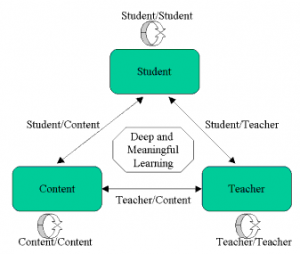
Anderson’s Modes of Interaction
Each of these can play an important role in a learning experience. Sometimes learning happens through dialogue with an instructor or peers. Other times it happens through thoughtful engagement with readings, videos, simulations, or other learning materials.
Many learning designers also draw on the Community of Inquiry (CoI) framework (Garrison, Anderson, & Archer, 2000), which emphasizes that meaningful online learning emerges through the interplay of three forms of presence:
-
Social presence: learners feeling able to express themselves and connect with others
-
Cognitive presence: learners actively constructing meaning through reflection and discussion
-
Teaching presence: the design, facilitation, and guidance of the learning experience
Interaction plays a central role in all three. Discussions, collaborative activities, feedback, and reflective tasks can all contribute to building a learning community where ideas are explored, challenged, and refined.
At the same time, not every learning activity needs to involve conversation with others. Some interactions happen entirely within the learner’s own thinking – when new ideas connect with prior knowledge and lead to new understanding.
Designing for Interaction
As you plan your Interactive Learning Resource, it’s worth thinking about how learners will interact within the experience you are designing.
Will learners:
-
interact primarily with content?
-
interact with each other through discussion or collaboration?
-
receive guidance or feedback from an instructor or facilitator?
-
engage in reflection or problem-solving that deepens their thinking?
There isn’t one “right” type of interaction. But thoughtful learning design usually includes opportunities for learners to engage with ideas, with others, and with the learning environment in ways that support meaningful learning.
References
Anderson, T. (2003). Getting the mix right again: An updated and theoretical rationale for interaction. International Review of Research in Open and Distance Learning, 4(2), 1–14.
Garrison, D. R., Anderson, T., & Archer, W. (2000). Critical inquiry in a text-based environment: Computer conferencing in higher education. The Internet and Higher Education, 2(2–3), 87–105.
Wagner, E. D. (1994). In support of a functional definition of interaction. American Journal of Distance Education, 8(2), 6–26.

Leave a Reply