
A theoretical framework is a set of ideas and theories that helps explain why things happen the way they do in a study. This provides a foundation for understanding the relationships between different concepts and guides the research process. Using a theoretical framework researchers can organize their ideas, develop research questions, and decide how to collect and analyze data. Theoretical frameworks are useful for researchers because they provide a structured way to connect theories to real world research they help researchers narrow their focus, develop meaningful research questions, and ensures that their study builds upon existing knowledge in a logical and organized way.
Some of the most common theoretical frameworks used in education are presented below.
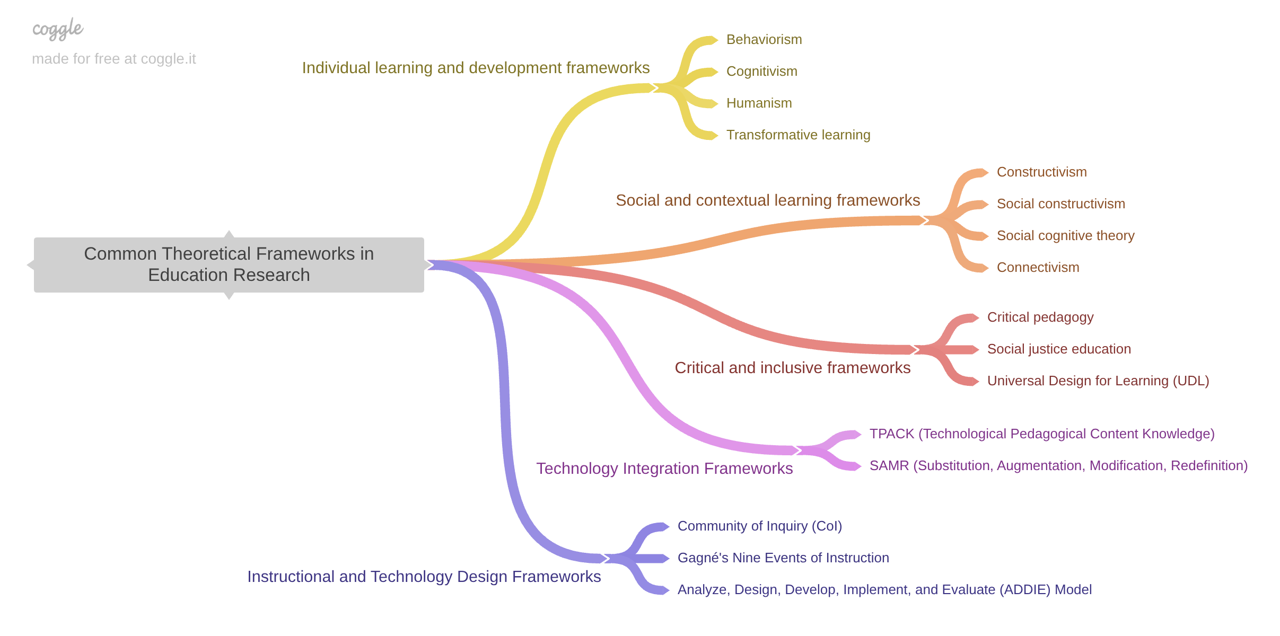
Identifying the Theoretical Framework within a paper
To find the theoretical framework in a research paper, you’ll need to look for the section that explains the existing theories and concepts that underpin the study. When reviewing a paper you may find a dedicated section of the paper that outlines the theoretical framework, or you may find it is nested within the literature review, and in some cases it is not mentioned at all. It is an important component that you will need to consider for your own research. So take note of how authors are positioning, using, and developing their work around these frameworks.
A theoretical framework is very useful when explicitly stated and used to guide the research. Think of it as the blueprint the author uses to build their research. It provides the structure and justification for the research questions, methodology, and analysis.
Here’s a step-by-step guide to help you locate it:
1. Check the Introduction and Literature Review
The theoretical framework is often introduced early in a research paper, typically in the introduction or as part of the literature review.
- Introduction: Look for statements that outline the key concepts, theories, or models that the study is based on. The author might explicitly state the theoretical lens they are using.
- Literature Review: The literature review section discusses previous research on the topic. The theoretical framework is often integrated here, showing how the current study builds upon, challenges, or extends existing theories.
2. Look for Explicit Mentions
Authors will often explicitly use phrases to signal the theoretical framework. Keep an eye out for terms like:
- “This study is based on…”
- “The theoretical framework for this study is…”
- “This research is informed by…”
- “The work of [theorist’s name]…”
- “…’s theory of…”
3. Identify the Key Concepts and Their Relationships
The theoretical framework will define the core concepts of the study and explain how they are related. Ask yourself:
- What are the main variables or concepts being investigated?
- How does the author define these concepts?
- What theories are used to explain the connections between these concepts?
For example, a study on student motivation might draw on Self-Determination Theory, defining concepts like autonomy, competence, and relatedness.
4. Examine the Research Questions and Hypotheses
The research questions and hypotheses are directly linked to the theoretical framework. The framework provides the basis for the questions being asked and the predictions being made. By understanding the core questions, you can often infer the underlying theoretical assumptions.
5. Scan the Discussion Section
In the discussion section, the author interprets the findings of the study. They will often refer back to the theoretical framework to explain their results and discuss the implications of their findings in relation to the initial theories. This can be a good way to confirm the theoretical foundation of the paper.
Video
Here is a brief and helpful video that seeks to explain the importance of the theoretical framework in research.
This page was developed with assistance from Google Gemini Generative AI.


Leave a Reply