
Topic Learning Objectives. By the end of this section you should be able to:
- Consider elements of connectionism when creating and evaluating effectiveness of multimedia in learning
- Consider myths may have wrongly have influenced educational planning in the past
- Discuss the Principles of Learning and how they may influence multi-media teaching and learning
- Formulate an opinion on game based learning
- Utilize active and passive learning concepts in your media curation
- Note scholars associated with the field (Ivan Pavlov, B.F. Skinner, E.L. Thorndike, Albert Bandura, etc.)
Introduction
Topics here vary from broad concepts to specific theory. Some of this content may be review from other course work or new but either way much of it will be the basis of what is covered in the EDI 337 content. Utilizing key elements in your multimedia creation and for each of your assignments is the aim. Hopefully those theories will be used in your future projects too, so that the multimedia objects you create are as effective as you can make them.
Key learning theories
Principles of Learning
Within the conventionally accepted Principles of Learning are the original three (Law of Readiness, the Law of Exercise, and the Law of Effect) that Edward Thorndike first wrote about nearly a century ago. Since then many more have been added with some debate. The accepted number is debated still. Each will have relevance to creating content. The OECD has set out the .pdf below which connects these principles of learning with the aim of creating effective learning for the 21st Century.
This week, we’re going to dive deep into learning theory. Throughout history, a number of different learning theories have been put forth, that fall into a few different paradigms. At different times, different theories have been the predominant educational paradigm in the Western world, but as Kevin Alexander says in the podcast below: “there’s always a little bit of truth in all of them.”
Let’s start our journey through learning theory with a brief introduction to the overall concept.
As mentioned above, learning theory has evolved over time. This six-minute video below takes us through the history of learning theories, and highlights the most well-known paradigms.
You’re not expected to memorize the different learning paradigms and theories. However, as you work with different tools throughout this course, and begin to design your own learning materials, I encourage you to refer back to these learning theories to help you make decisions about how best to design your own learning materials and assignments for this class.
Spend some time reading the above embedded OECD .pdf as part of the readings this week.
Also click each link in the below list of Principles of Learning:
Brining these elements into our multimedia teaching and learning can help to add a new level of effectiveness. Returning to these often when you are creating your multimedia artifacts can help build your content on a sound footing with the aim to being as effective in delivering your messaging. In time you may see these become habit and naturally apart of what you will create. Ultimately your content creation can benefit if based upon these Principles of Learning. Again, below are the briefest of introductions to these massively important and foundational elements of education and more broadly psychology and should be seen as only a tiny cursory glance. Take your time with the content and if more information is necessary please look up on your own.
Connectionism
Over time Thorndike’s work became one of the basis for the instructional design theories know as connectionism. Please watch below an informative video presented by Chris Lee that links these important concepts.
Behaviorism
Behaviourism defines learning as a change in behaviour that occurs as the result of positive or negative reinforcement, or through punishment. Positive stimuli (rewards) create positive associations between the behaviour and the reward, prompting the learner to repeat the behaviour. Punishment creates negative associations between the behaviour and the punishment, prompting the learner to avoid the behaviour. Behaviourism focuses largely on rote learning; it’s through repetition and reinforcement that learning happens.
- Key theorists: Ivan Pavlov (Pavlov’s dogs experiment), B.F. Skinner (operant conditioning), E.L. Thorndike, Albert Bandura (Bobo doll experiment)
- If you’ve taken an introductory psychology class, you may recognize some of these names!
- Application: Many of the basic teaching methods still in use today stem from the behaviourist paradigm. This includes strategies such as explaining, demonstrating a skill or behaviour, inviting student practice, and providing feedback.
- Critique: Behaviourism is often criticized for underemphasizing biological and unconscious factors, denying free will, equating humans with animals, and overlooking internal learning processes or types of learning that occur without reinforcement.
Cognitivism
Cognitivism focuses on a learner’s mental processes, such as thinking, memory, knowing, and problem-solving. Rather than simply responding to stimuli, cognitivism views the learner as an information processor (kind of like a computer) and believes changes to a learner’s behaviour are a consequence of thinking. Cognitivism defines learning as a change in a learner’s schemata, or what or how they think, rather than how they behave.
- Key theorists: Jerome Bruner, Robert Mills Gagne, Marriner David Merill, Charles Reigeluth, and Roger Schank
- Application: The cognitivism paradigm emphasizes the importance of an expert to transmit accurate information- a technique still common in education today. Self-reflection, a form of thinking that often results in a changed schema for an individual, is also a cogntivist technique.
- Critique: Most contemporary educational psychologists today view the cognitivist paradigm as outdated.
Constructivism
Constructivism views learning as an active, contextualized process of constructing knowledge, rather than simply acquiring it. Learners create their own subjective information by interpreting their world, restructuring their thinking, and building on past experience. Knowledge is constructed based on personal experiences and hypotheses that are then tested.
- Key theorists: John Dewey, Jean Piaget, Lev Vygotsky and Jerome Bruner
- Application: In the constructivist paradigm, the teacher serves as more of a guide rather than the source of a student’s learning. Learners are given the opportunity to learn through discovery, and to make and test hypotheses. The common teaching practices of posing questions and allowing students to answer them in their own way, and welcoming multiple points of view, are constructivist techniques.
Social constructivism
Social constructivism is the newest iteration of the constructivism paradigm that takes it one step further. While constructivism view learning as an individual endeavour, social constructivism acknowledges that learning also happens through social negotiations. Hypotheses are often tested through our interactions with others, and group work in often used as a collaborative learning tool. Social constructivism is currently the dominant educational paradigm.
Each of these paradigms has many learning theories that fall underneath. If you’re interested, you in learning more, you can explore the Learning Theories website.
If you’re interested in a quick chart comparing the different learning paradigms, check out the comparison chart created by the University of California, Berkeley.
Myths about learning
After reading about all these different learning theories, you may be beginning to realize that there’s a lot we don’t know about how we learn. The field of learning science is still relatively new, and we’re constantly learning new things and more things. As we learn more about neuroscience and how the brain works, those insights contribute to our understanding of how we learn as well.
Over the years, as we’ve tried to identify how we learn, a number of different beliefts have taken hold, several of which have become mainstream pop culture. Unfortunately, some of these common beliefs are not substantiated by research, and others have been debunked by research, yet continue to exist in our mainstream culture. Some of these learning myths are very likely things that you believe. Before we start debunking a few of these myths, take this NPR quiz to find out which of your beliefs are actually myths.
How did you do? Were you surprised by any of the answers?
Neuromyths
The decade from 1990 – 2000 was declared the “Decade of the Brain” in the United States. Over the past 30 years, due in part to advances in technology, we have been able to learn more and more about how our brains work. In some cases, we have taken our new understanding of how the brain works and extrapolated the findings to attempt to define how we learn. This has led to the creation of what the Organization for Economic Cooperation and Development (OECD) calls “neuromyths.”
“The genesis of a neuromyth usually starts with a misunderstanding, a mis-reading and in some cases a deliberate warping of the scientifically established facts to make a relevant case for education or for other purposes.”
OECD, 2002
Neuromyths often stem from the popular press, who oversimplify the findings of research study in order to appeal to the greatest number of people.
The OECD has identified six different neuromyths that are pervasive in education today.
- The brain is only plastic for certain kinds of information during specific ‘critical periods’
- ‘Enriched environments’ enhance the brain’s capacity for learning (neuromyth #2)
- There is a visual, auditive and a haptic types of learning (neuromyth #3)
- We only use 10% of our brain (neuromyth #4)
- The fifth neuromyth is a collection of myths about multilingualism (neuromyth #5)
- Two languages compete for resources
- Knowledge, acquired in one language, is not accessible in the other language
- The first language must be spoken well, before the second language is learnt.
- The left brain/right brain myth (neuromyth #6)
Some of these myths are more relevant to our purposes than others, as they have a greater tendency to impact instructional design strategies. We’ll explore those more below! If you’re interested in learning more about any of the other neuromyths, feel free to click the links above. It’s not necessary though!
Right vs. left-brained
Would you describe yourself as more logical, methodical and analytical, or more creative and artistic? If it’s the former, popular culture would say you’re left-brained. If it’s the latter, popular culture would put you in the right-brained bucket.
Unfortunately, there’s no evidence that people use one side of their brain over the other. In fact, we’re pretty much all in the “whole brain” bucket. While it’s true that some brain functions, such as speech, are localized to one part of the brain, “it’s the connections among all brain regions that enable humans to engage in both creativity and analytical thinking.”

Learning styles
Have you ever taken a test to determine your learning style? Did you find out that you’re a visual learner, or maybe an auditory learner, or a kinesthetic learner? Ultimately, it doesn’t matter what learning style an internet test told you you were, because learning styles are a myth. While there are certainly differences in how individuals learn, there are many reasons why learning styles don’t accurately describe those differences. Learning tasks aren’t always well-suited to a learning style (can you really learn to identify bird calls through some sort of visual learning, or learn to spell by simply hearing the words?). Even more, research has found that:
Growth mindset, or fixed mindset?
Some people believe that you’re either good at something, or you’re not. They believe that if you’re not good at archery the first time you try it, for example, you’ll never be good at it. Substitute math for archery, and you can see this way of thinking in lots of kids! This is called a fixed mindset- you believe that you’re abilities are fixed from the get-go.
Other people believe that you’re not good at something… yet. You might not be good at archery the first time you try, but if you keep practicing, you can get better, and eventually you can become quite good. This is called a growth mindset- you believe that your abilities can grow and improve.
The idea that we can’t always continue to learn is a myth. Our brains are always (barring certain advanced diseases, perhaps) capable of learning new things and developing new connections.
Carol Dweck is a researcher who has become well-known for popularizing the growth mindset. Watch her 10-minute TED Talk to learn more.
Active and Passive Learning
There is a large and growing body of research that indicates that active learning techniques tend to lead to higher grades and longer-term recall of skills and facts than passive learning techniques. So if it’s true that active learning is more effective than passive learning, is there a place for passive learning in educational settings? OSIE at the University of Toronto sees this shift as part of the ongoing transformative practices that is on going within education. Giving learners opportunities to use active learning experiences should be a consideration within your own practice.
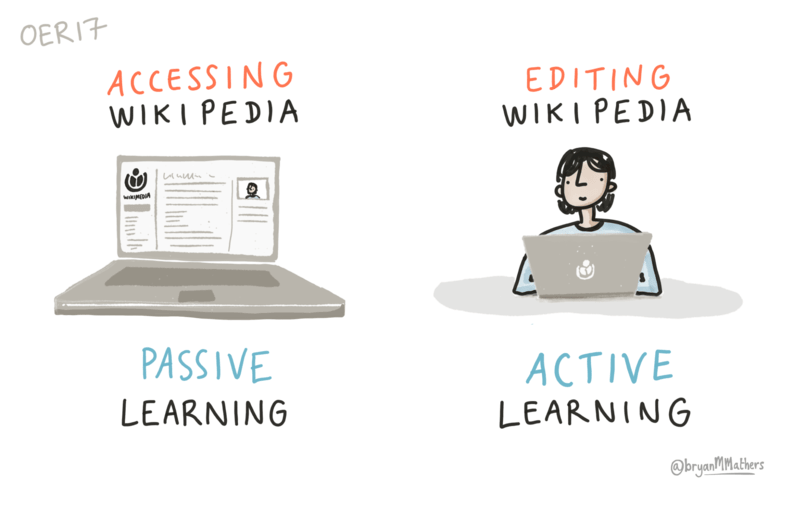
Active Learning
What is Active Learning? Generally speaking, Active Learning, is an approach to instruction that involves actively engaging students with the course material through hands-on skill-building, discussions, problem-solving, reflective writing, case studies, and other methods (What Is Active Learning, n.d.). What is Passive Learning? Common passive learning techniques include traditional lectures, reading, and watching videos.
Now that we have a grounding in what Active Learning is, what does active learning typically look like? As you watch the following video, please think of how you could use active learning techniques in persuasive presentations and video instruction that you might need to create in the future.
Active learning is definitely not a new concept, even if some of the tools we now have at our disposal for multimedia learning are new. What active learning looks like in any given situation will depend on the audience (or learners) and the learning outcomes for the topic or skill to be learned. Read the first 3 tips in the following excellent article that outlines 5 tips for multimedia-enhanced learning. Please pay special attention to Bloom’s Taxonomy and think about how you could use technology to create activities that would use higher-order skills in the taxonomy.
How can I do this?
Quickly there are a number of ways to incorporate active learning suggestions in ether a face-to-face or online classroom. Each should mean students become more engaged in the learning process. Here are some suggestions from Oregon State University:
- Add a personal reflection component (like your weekly blogs) to help students uncover new ideas or insights
- Offer opportunities for students to practice and examine concepts with peers, such as debates (Pods)
- Break lectures into small, granular topics and intersperse with questions or problem-solving activities based on real-world applications (Our weekly hands on tasks)
- Consider “flipping” the classroom by asking students to read or watch lecture videos before in-person class sessions
- Incorporate game based elements
In sum active learning has the potential to (University of South Carolina- Center for Teaching Excellence):
- Provide insight into students’ prior knowledge
- Help students gauge their own understanding of course concepts
- Increase student motivation and engagement
- Promote the application of problem-solving skills
- Improve critical thinking skills
- Re-energize and refocus a lesson
- Assist students with creating personal connections
- Create a sense of community in the learning environment
- Promote student-student and student-instructor interactions
Game-Based Learning and Gamification

Gaining popularity, using game elements or outright games as a means of teaching both gamification and game-based learning are important when considering multi-media and interactive learning.
Active learning can be made possible in teaching material that uses gamification and game-based learning. In game-based learning, the game is the learning experience, whereas in gamification, the game components are added to the traditional instruction method. Gamification in education refers to the introduction of game design elements and gameful experiences in the design of learning processes Christo Dichev & Darina Dicheva article Gamifying education: what is known, what is believed and what remains uncertain: a critical review, discuss this in detail and define these terms well. Please read this article as part of your work this week.
Motivation is among the important predictors of student achievements, which influences the effort and time a student spends engaged in learning. Given that games, known to engender motivation and engagement, are notably popular, the proposal to incorporate game mechanics and principles to motivate the learner is appealing
The line between Game Based Learning and gamification is sometimes very thin
Game-based learning includes a specific game-like environment with a context to the game. Learning content is often through activities like theatre and role play. Subsequently, the learning process comes as a result of playing the game.
Game-Based Learning – Best Practices From University of Toronto
These recommendations are based upon current academic literature about the impact of game based learning. They make the following Game-Based Learning recommendations:
1. Speak the language of games – when including a game into the curriculum, embed the language and reward structure of gaming into the design of the course and the syllabus.
2. Play games, but don’t let the mode overwhelm the content – It is important to balance content of the game with the requirements of the game.
3. Customize the level of challenge – Students learn best when they are challenged, but not challenged too much. Additionally, there should be different ways of approaching the game, and groups should be able to work at different levels to best match their styles.
4. Avoid games that focus on rote memorization, but instead, focus on open environment, creating a space for reflection.
5. Frame the game so that students understand how the game supports learning goals.
6. Give specific formative feedback by telling students specifically how current knowledge differs from the goal, and give clear instruction on what they can do to complete the game more effectively.
7. Give students enough time to practice new skills because in order for new knowledge to be retained across time and transferred to new context, time is needed for them to develop the skill properly.

Gamification
To differentiate from Game-Based Learning: Gamification is about adding or inserting some elements of a game into traditional activities. This means that elements of gamification can be within game based learning, however the opposite is not true.
Although Quizzes can be considered an example of gamification, tools like web apps for creating quizzes, such as Kahoot, Gimkit, Quizlet or Quizizz, are not considered Game-Based Learning. They are just quizzes, a stack of questions, a story, or an environment without characters or rules – hence not Game-Based Learning.
Why incorporate game elements?
- Incentivizing student ‘exploration’ of content by offering bonuses, ‘easter eggs’ or badges
- Using levels, checkpoints, and other methods of ‘progression’
- Creating competition
- Creating play
- Social
- Multimedia
- Problem solving
Examples of Gamification:
- Separating students into groups to compete on assignments or activities.
- Enabling students to earn points for behavior or completion of assignments and allowing them to spend the points on rewards.
- Timed flash cards or worksheets.
- Badges to show completion of work or mastery of skills.
- Listening for certain keywords or situations to complete a bingo-type sheet.
- Using dice to generate random numbers for a worksheet activity.
If you like games or are interested in making games please read this fantastic synthesis of Principles of Learning and Flow applied to games (optional reading).

Weekly Activity: Hands-on Tasks
The hands on portion will be not as structured as other weeks. Instead you are to browse some of the mentioned game tools. Feel free to dig deep on a few, reading reviews, watching videos but definitely take a look at what is possible for your teaching and learning with interactive and multi-media. A place to start may be UVic’s own resources page! Other possibilities:
SecondLife (UVic)
MinecraftEDU (UVic)
More Places:
- STEAM
- Twitch Education Search
- https://www.abc.net.au/abckids/games/
- https://pbskids.org/games/
- https://rtejr.rte.ie/play/
- https://www.tvokids.com/school-age/games
Tasks & Assignments This Week:
- Post weekly blog post (if stuck ideas below)
- Work through all material above
- Meet with Learning Pod – you should have selected a partner(s) for Assignment 4 and divvied jobs
- Comment on 1 Pod Members Blog
- Hands on Learning this week is to look up some of the Gamification tools mentioned in the articles and videos in this topic post. Search for other Gamification apps and explore what they offer
- Blog ideas and prompts: (These are some ideas you could blog about this week)
- Thinking about your previous learning experiences, can you identify which learning paradigms were used?
- Which learning myths did you believe prior to this lesson? How have these myths impacted your education in the past (or have they?)?
- What’s your experience with a fixed mindset vs. a growth mindset? Have you been in situations where you have had a fixed mindset? A growth mindset? Have your previous instructors encouraged you to have a growth mindset?
- Unpack the Game Based Learning and Gamification misconceptions
- How do Game Based Learning and Gamification use active learning?
- Examples you have been a part of in your classes of Game Based Learning
- Examples you have been a part of in your classes of Gamification
- What game tools or ideas have peeked your interest?
- How could assessment drive Gamification in a learning environment
Bibliography
Centre for Teaching Excellence at the University of South Carolina. (2021). Active Learning. https://sc.edu/about/offices_and_divisions/cte/teaching_resources/active_learning/index.php
Dichev, C., Dicheva, D. Gamifying education: what is known, what is believed and what remains uncertain: a critical review. Int J Educ Technol High Educ 14, 9 (2017). https://doi.org/10.1186/s41239-017-0042-5
Differentiated instruction. (2021). In Wikipedia. https://en.wikipedia.org/w/index.php?title=Differentiated_instruction&oldid=1003087062
Game Based Learning. (2021, May) University of Toronto. https://guides.library.utoronto.ca/c.php?g=448614&p=3507705
Mathers, B. (2017). Wikipedia – Active vs Passive learning. https://bryanmmathers.com/wikipedia-active-vs-passive-learning/
MBR University. (2019, November 9). What is…Active Learning? [Mp4]. https://www.youtube.com/watch?v=Z9esoCjjUGQ
Oregon State University. (2019) Active Learning: What Does the Research Show. https://blogs.oregonstate.edu/inspire/2019/03/01/active-learning-what-does-the-research-show/
Stansberry, S. (n.d.). Differentiated Learning with Educational Technology. In Applications of Educational Technology. Oklahoma State University Libraries. Retrieved March 13, 2021, from https://open.library.okstate.edu/applicationsofeducationaltechnology/chapter/chapter-2-differentiated-learning-with-educational-technology/
Top Hat. (2018, November 26). Active Learning: How Professors Should Teach [Mp4]. https://www.youtube.com/watch?v=IOcgBCVbHNg
What is Active Learning? (n.d.). Queens University – Teaching & Learning. Retrieved March 12, 2021, from https://www.queensu.ca/teachingandlearning/modules/active/04_what_is_active_learning.html
Alexander, K. (2017). How We Learn—Learning Theories [Mp3]. https://soundcloud.com/user-433569679/how-we-learn-learning-theories
CAST. (2018). Universal Design for Learning Guidelines version 2.2. Retrieved from http://udlguidelines.cast.org
CAST. (n.d.). About UDL. UDL on Campus. Retrieved from http://udloncampus.cast.org/page/udl_about
Driscoll, M., & Carliner, S. (2005). Advanced web-based training strategies: Unlocking instructionally sound online learning. John Wiley & Sons.
DeBell, A. (2019, December 11). How to Use Mayer’s 12 Principles of Multimedia Learning. Water Bear Learning. http://waterbearlearning.com/mayers-principles-multimedia-learning/
EON Reality. (2019, May). WHAT WILL THE CLASSROOM OF 2030 LOOK LIKE FOR THE STUDENT OF THE FUTURE? https://www.youtube.com/watch?v=F_-GCrw24ic
Garzón, J., Pavón, J. & Baldiris, S. Systematic review and meta-analysis of augmented reality in educational settings. Virtual Reality 23, 447–459 (2019). https://doi-org.ezproxy.library.uvic.ca/10.1007/s10055-019-00379-9
Kamenetz, A. (2017, March 22). You probably believe some learning myths: Take our quiz to find out. NPR. Retrieved from https://www.npr.org/sections/ed/2017/03/22/520843457/you-probably-believe-some-learning-myths-take-our-quiz-to-find-out
Khazan, O. (2018, April 11). The myth of ‘learning styles’. The Atlantic. Retrieved from https://www.theatlantic.com/science/archive/2018/04/the-myth-of-learning-styles/557687/
Kurt, S. “Instructional Design Models and Theories,” in Educational Technology, December 9, 2015. Retrieved from https://educationaltechnology.net/instructional-design-models-and-theories/
Lee, Chris. (2018) Instructional Design Models and Theories: Connectionism. Arizona State University https://www.youtube.com/watch?v=oYd6xIz1q-U
OECD. (n.d.) Neuromyths. Retrieved from https://www.oecd.org/general/searchresults/?q=Neuromyths&cx=012432601748511391518:xzeadub0b0a&cof=FORID:11&ie=UTF-8
OECD. (2002). Learning seen from a neuroscientific approach, Understanding the Brain: Towards a New Learning Science. https://www.oecd.org/education/ceri/31706603.pdf
Summaries of Learning Theories and Models. (n.d.). Learning Theories. Retrieved September 12, 2021, from https://www.learning-theories.com/
The Computer Science Education Research Group Augmented Reality (AR) Simulations with Merge Cubes. https://www.youtube.com/watch?v=ahJIzV6yE00
Underhill, C. (2018). Design Principles for Multimedia. In UBC Wiki.
Wanjeck, C. (2013). Left Brain vs. Right: It’s a Myth, Research Finds. Live Science. https://www.livescience.com/39373-left-brain-right-brain-myth.html


Leave a Reply