
Inba has shared her slides from the talk last week on open scholarship. She is also happy to support if you have further or specific questions related to open access, journal assessment, or the Support for OA publishing (SOAP) agreement that enables you to publish open access without APC in many excellent journals. I have highlighted a couple more useful resources below.
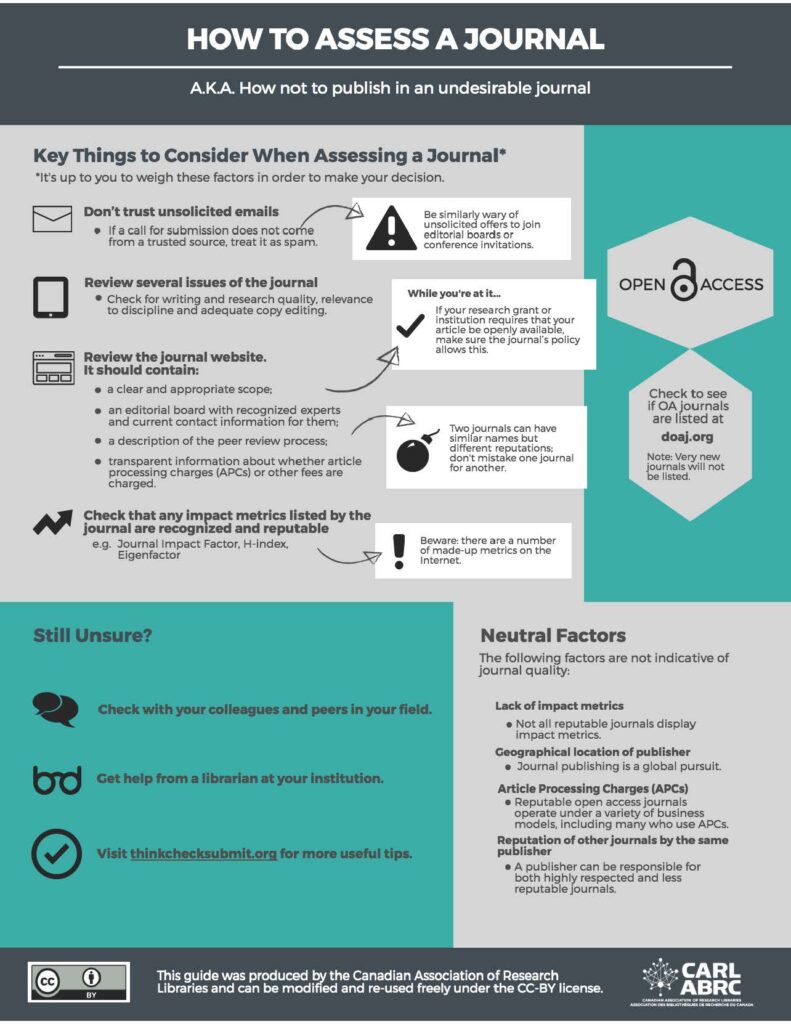
Assessing Journals Infographic
Open Licensing for Research with Creative Commons
Summary of Changes under Consideration for the Tri Agency Mandate
| Feature | 2015 Policy (current) | Draft Revised Policy |
| Open Access Timeline | Within 12 months of publication | Immediate upon publication |
| Rights Retention | Not explicitly required | Required |
| Repository Deposit | One of two options for compliance | Mandatory at time of publication |
| Preprints | Not mentioned | Accepted for compliance if immediate deposit is not possible |
| Implementation | In effect for grants awarded since 2008 (CIHR) and 2015 (NSERC & SSHRC) | To be implemented for grants and awards from January 1, 2026 |
Consider Setting up an OrchidID
Inba also mentioned that it might be a good idea to sign up for OrchidID, if you have not already. The OrchidID (aka Open Researcher and Contributor ID), is a name-independent person-identifier founded specifically to help solve the problem of name ambiguity in research and to enable transparent and trustworthy connections between researchers, their contributions, and their affiliations. You will find more and more journals and academic conferences will request your ID when submitting proposals. The ID also gets updated automatically as your linked scholarship is published. Here is some support for getting setup.
Preparing for Next Week
I am still working on pulling together some support materials for your literature review and presentation. I will add these to the assignments page as I curate along with the rubrics. I should have this up by Monday.
Please read the Berliner (2002) article titled ‘Educational Research: The Hardest Science of All’ for this coming week.
If you are doing research in educational technology, I also highly recommend you review the additional articles that suggest directions for research in the field. I appreciate these articles as they critique the current state of research and offer suggestions on areas of focus, method, and lenses to consider for future researchers. See Hennessy et al. (2023), Schmidt et al. (2025), Selwyn et al. (2019), and Williamson et al. (2019), all open access.
You will find all the readings linked on the reading source file page.


Leave a Reply